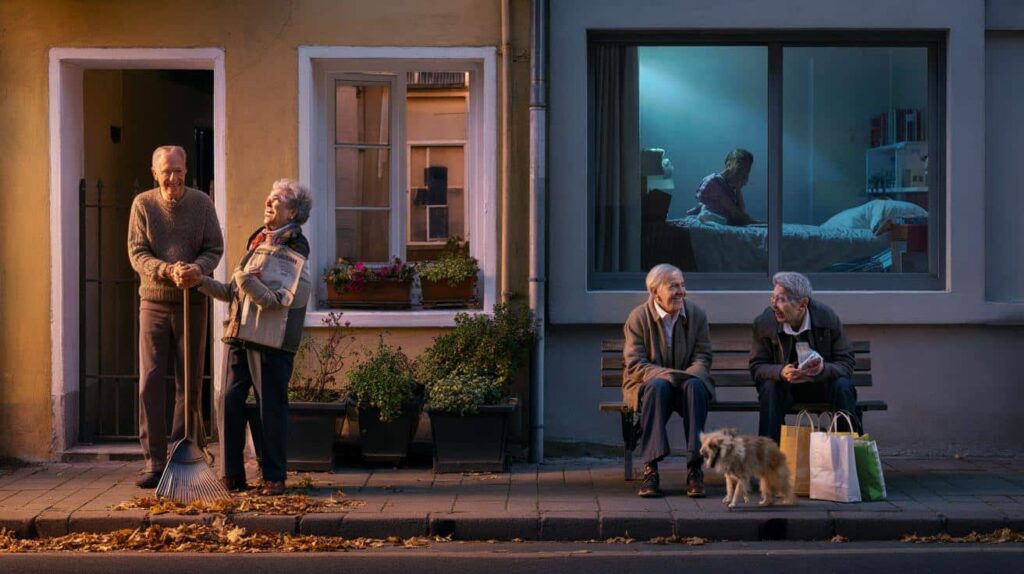
No alarm clock on Saturday morning. The only sound on the street is the slow scrape of a broom on the sidewalk. A man in his 70s or 80s is sweeping up leaves in front of his small gate. Every now and then, he stops to lean on the handle and talk to a neighbour who is passing by. He didn’t have a phone. No earbuds. The air, the leaves, and a calm look on his face.
A teenager across the street is scrolling through their phone in bed, their face lit up blue by the screen. They are already deep into three different apps before breakfast. Different worlds on the same street.
You can almost tell which one has a slower heart rate.

And you start to wonder what these quiet, almost invisible habits are that make so many people in their 60s and 70s look… lighter?

Nine small habits that quietly beat constant notifications
If you watch people in their 60s and 70s for a whole day, you’ll see a pattern. Yes, they move more slowly, but they also move in a way that tech-savvy twenty-somethings seem to have lost. The day is not a race; it’s a series of familiar, almost sacred stops.
They give plants water. They go to the bakery on foot. They talk to the same person at the register. They both sit on the same bench in the park. From a distance, it can look boring or even stiff. When you look closely, it’s a pretty advanced way to keep your emotions in check.
These “boring” rituals are often what keep them from feeling empty and burnt out.
Lucia, 72, lives on the edge of a mid-sized city. For the past twenty years, her mornings have been pretty much the same. She wakes up at seven, opens the window in her kitchen, brews coffee in a dented moka pot, and reads a real paper newspaper, carefully folding it along the creases.
Her 19-year-old granddaughter tried to get her to buy a tablet. She said, “You can get all the news, TikTok, and podcasts.” Lucia smiled, shook her head, and flipped the page. She said, “I like my coffee hot and my paper loud.” That ritual, which she does hundreds of times, keeps her grounded. She said she doesn’t often wake up feeling anxious.
You could call it low-tech, but that slow breakfast might be better for her mental health than any mindfulness app.
These habits make sense in a clear way. When you don’t let your smartphone run your life, your brain quietly starts to build its own structure. Taking regular walks keeps your body moving. Fixed meal times help control energy. Instead of spreading your attention across hundreds of contacts, regular calls or visits with the same small group of people strengthen your bonds.
Psychologists call small, repeated actions that help keep mood and decision-making stable “behavioural scaffolding.” Older people often just do it without the jargon. They keep their sleep safe. They don’t just plan their week around notifications; they also plan around real-life events. While younger people are always looking for new things and faster ways to do things, a lot of people in their 60s and 70s are quietly winning at something harder to measure: being happy every day.
The habits that keep them calm: what they really do differently
One of the most interesting things about them is that they plan time for people like it’s air. Not huge, showy parties. Small, reliable moments. A lunch every week. A card game on Tuesday. A phone call every day at the same time.
These aren’t plans for “when we have time.” They are set in stone for the week. A 68-year-old man in Lyon told me that every Wednesday at 10 a.m., he has coffee with the same three friends. He laughed and said, “If one of us doesn’t show up, we call the hospital.” There is a quiet truth behind the joke: they don’t hire out friendship to group chats. They come in person and on time.
You also see how they keep boredom at bay. They don’t take out their phones while they wait in queue. They sit on a bench and watch people go by. They sit on the bus for a long time and look out the window with their hands on their bags.
Younger people often see any quiet time as a chance to fix things with content. Older people, especially those who seem happy, see silence as a place to relax. That’s where worries are put to rest, memories come back, and solutions quietly show up. We’ve all had that moment when the best idea comes to you while you’re just staring at nothing. They let more of those times happen. Instead of always reacting, they can let their minds breathe.
Another thing that stands out is how they treat their bodies. A lot of people walk every day, but they don’t call it a “workout” or a “step goal.” They walk to get bread. To send a letter. To see a friend. Movement is a part of life, not something you have to do as a punishment for sitting all week.

To be honest, no one does this every single day. They don’t do their work, they get lazy, and it rains on them. But the baseline is not the same. If you ask them how they stay in shape, they say, “I use my legs.” That simple way of doing things makes you feel less guilty and stressed. It’s not about how well you do, it’s about staying the same. That long game mindset makes them more forgiving of themselves, and the result is surprisingly modern: exercise that lasts, without apps, leaders, or shiny water bottles.
How to get their advice without throwing your phone in the river
You don’t have to move to a village or get a landline to use these old habits. You can start out very small. Pick one thing you do every day that you will do at the same time, in the same way, and without your phone nearby. It could be the first 15 minutes after you wake up: drink a glass of water, open a window, take three deep breaths, and stretch quickly. That’s all.
Think of it as an island in a digital sea. Keep it safe. Put your phone face down in another room. *Make that one small habit something you can’t change. As your brain gets used to and starts to like it, you can add a second habit, like a daily walk around the block, a set time to read before bed, or a weekly call with someone who really matters.
All-or-nothing thinking is a trap that a lot of tech-savvy young people fall into. They either do a 30-day hardcore detox or they stay on the screen. The older people I talked to didn’t talk like that very often. They change, they bend, and they start over on Monday.
So be gentle. Pick one ritual for your body and one for your social life. Maybe it’s Friday night dinner with no phones or tablets on the table. Maybe it’s getting your coffee by walking instead of ordering it. Instagram shouldn’t show off progress here. In real life, it should feel a little boring and strangely comforting. You’re probably on the right track if you feel a little better.
A 71-year-old woman told me, “People think we’re nostalgic, but we’re just protecting what keeps us sane.”
- Keep one daily ritual completely offline, like your morning, meal, or evening wind-down.
- Make sure you have at least one regular in-person meeting every week.
- Walk for a reason, not just to “hit steps.”
- Instead of filling every gap with a screen, let yourself be bored for short periods of time.
- Instead of talking to everyone once in a while, talk to the same people a lot.
The quiet rebellion of living at a human pace
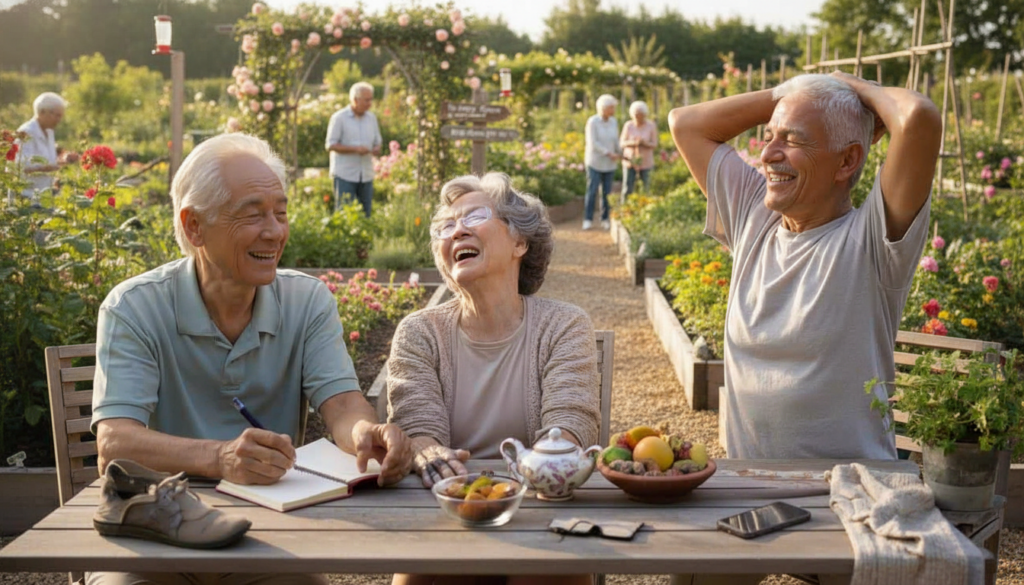
If you really look at them, the happiest people in their 60s and 70s aren’t just “old-fashioned.” They are quietly fighting against a culture that sees rest as a sign of weakness and attention as a form of currency. Their rebellion looks soft: a garden, a long talk, a walk with the dog, and a notebook. But the effect is strong. Less stress. Stronger connections. A more steady feeling that today is good enough, even if it’s not perfect.
You don’t have to wait years to say that. You can know a lot about technology and still live at a normal pace. You can eat dinner slowly and answer emails quickly. You can look at memes and still keep one or two habits private and offline. The question isn’t really “how old are you?” but “what are you willing to calmly repeat for years?”
That’s where happiness grows quietly: in nine small, stubborn habits that look normal on the outside but feel like air on the inside.
Main pointDetailValue for the reader
| Rituals that stay the same | Set aside time for simple things you can do offline, like eating breakfast, going for a walk, or reading. | Helps you feel less anxious and more in control in a noisy world |
|---|---|---|
| Regular contact with people | Weekly phone calls or meet-ups with a small group | More than constant messaging, it builds emotional safety and fights loneliness. |
| Moving with a purpose | Walking or doing light activities while running errands | Helps health naturally, without apps, pressure, or a culture of guilt-based fitness |
Questions and Answers:
Question 1: What are some easy things I can do that people in their 60s and 70s do?
Question 2: Do I have to stop using social media to get these benefits?
Question 3: How do I get my friends to do something every week if they say they’re “too busy”?
Question 4: What if I get bored with routines and want something new?

Question 5: Can these habits really help you feel less stressed than wellness apps?