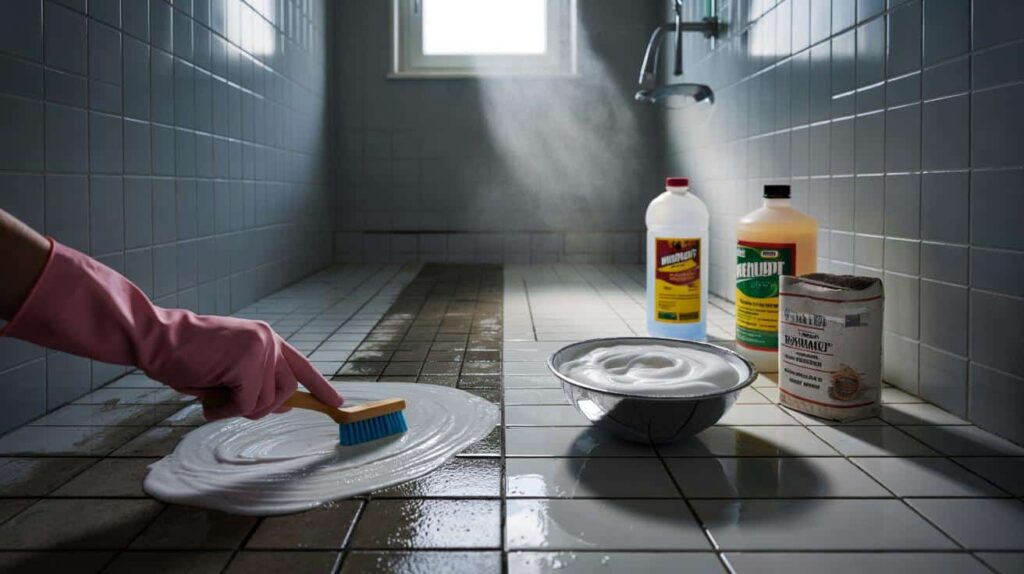
She could smell it before she even saw it. Marta was on her hands and knees in the bathroom, with pink cleaning gloves halfway rolled down, looking closely at the grout between the tiles. It had been a dull grey, almost black in some places, ten minutes before. The lines were getting bright and almost new after just a few quick strokes with a toothbrush dipped in a foamy paste. It was like a before-and-after ad on social media.
She coughed once, waved her hand in front of her face, and laughed it off. She thought, “It’s worth it,” and her eyes watered a little.
Three ingredients, fifteen minutes, and sparkling grout.

And in the air, something she couldn’t see.

The 3-ingredient grout trick that everyone is talking about
You’ve probably seen the “magic grout recipe” on TikTok or Reels if you’ve ever spent time cleaning them. A bowl, three household items, a quick stir, and that strange but satisfying moment when dirty lines between tiles suddenly look like new caulk.
The promise is tempting. No costly spray. No professional cleaning. Just a homemade potion taken from the kitchen cupboard and the laundry shelf.
One maker says, “In 15 minutes, your grout will shine.” One person says it “melts dirt like butter.” Millions of people are watching.
The basic recipe calls for baking soda, a little bleach, and a little dish soap. Some people put in vinegar. Some people use hydrogen peroxide instead of bleach, while others add a multi-surface cleaner “for power.”
They use a brush to spread the paste over the grout, let it sit, scrub, and then rinse. The pictures of before and after are very different. When you put foam on yellowed grout, it turns white and crisp.
People are saying, “Game-changer!” “Where has this been all my life?” “My bathroom smells like a pool, but I don’t mind.”
These mixes “work” for a reason. Baking soda is a little rough, which makes it great for cleaning dirt off of things. Bleach is a very strong stain remover, especially for mould stains. Dish soap gets rid of the greasy residue left behind by shampoos and body products.
On a chemical level, they’re doing exactly what you want them to do: getting rid of dirt, stains, and soap scum. The strong smell, the satisfying fizz, and the instant whitening all make it seem like the mix is strong.
But that same power can quickly become dangerous when mixed with other things.
Where the sparkle ends and the bad smells start
When people start “improvising,” that’s when the real tension starts. A little bleach here, a little vinegar there, and a capful of toilet cleaner “for extra oomph.” These small changes can turn a smart hack into a small chemistry lab in your bathroom.
For example, vinegar and bleach are a well-known pair. When mixed together, they can let out chlorine gas, which is bad for your lungs and eyes. That burning feeling in your throat or nose? It’s not just “strong cleaning power.”
In a small bathroom with bad air flow, a few minutes of that drink can be too much for your body to handle.
Poison control centers know this story by heart. A parent calls because they “cleaned the shower with bleach and something else” and now their child is coughing, feeling dizzy, and their eyes won’t stop watering. A young renter cleans the grout with a mix she made herself while the window is closed. She ends up sitting on the edge of the tub, gasping for air.
These aren’t just examples from a lab report. It’s Tuesday afternoons. The World Health Organization has been warning for a long time that cleaning products can make the air inside your home very dirty, especially in small, closed spaces like bathrooms.
Most of the time, people get away with it. So the trick gets around.
When some ingredients come into contact with each other, they don’t just add their strengths; they also make new things. Bleach and vinegar can let out chlorine gas. Bleach and ammonia (found in some bathroom and glass cleaners) can make chloramine gases. Both can make you cough, feel tight in the chest, and have trouble breathing.
Even “milder” combinations can bother the airways if you are in a small room and are exposed to them again and again. The grout looks great, but your lungs have been hurt without you knowing it.
Let’s be honest: before making their own miracle paste, no one really reads the small warning labels on the back.
How to quickly clean grout without making your bathroom smell like gas
You can get that 15-minute sparkle in a safer way. Make a simple paste out of baking soda and water that is thick enough to stick to the grout. Use an old toothbrush to smear it along the lines.
Spray it lightly with plain hydrogen peroxide, wait 5 to 10 minutes, and then scrub it. This combination gets rid of stains, kills a lot of germs on surfaces, and makes grout look brighter without the strong smell of a pool.

Don’t crouch down with your face inches from the paste the whole time. Instead, open a window and run the fan.
If you want the full power of bleach, use it alone, diluted, and with care. A little bit of this mixed with water and put on with a sponge or brush is all you need to whiten grout. Don’t ever add vinegar, toilet cleaner, or “just a little bit of everything” on top.
We’ve all been there: when the mess looks so bad that you want to throw half of the cleaning supplies at it. That instinct is normal for people, but it can get them into trouble.
It’s better to clean twice gently than once and then have something in your lungs that makes your chest tight all day.
Experts often sound boring until you realise that they are just describing what they see all the time.
Dr Laura Mendes, a pulmonologist in Lisbon, said it straight: “Most people don’t think about cleaning fumes because they’re “just doing the bathroom.” But being in a small room with chlorine or mixed gas can make your lungs feel like you have a bad chest infection. You might not think that the cough you have now is because of the grout you cleaned last week.
To be on the safe side, make a short mental list:
- Don’t mix chemicals together in a free-for-all; only use one at a time.
- If you have one, open the windows and doors and turn on the exhaust fan.
- Put on gloves and don’t breathe right above the grout line.
- Instead of covering the whole floor, try a small area first.
- Before going back inside, rinse well and let the room air out.
A clean bathroom isn’t worth having a burning chest or a splitting headache.
Shiny grout, hidden dangers, and the decisions we make at home
The story of those three magical ingredients is really about how we take care of our homes and bodies. We want results that are quick and easy to see. We want that satisfying TikTok moment, the clean grout that says, “I’ve got my life together,” even if the rest of the house is a little messy.
Brands and algorithms give prizes to anything that can change “disgusting” into “perfect” in less than 30 seconds. The camera never shows the smell, the sting in the throat, or how dizzy you feel when you step out of the bathroom.
There is no bad guy here. Just habits, shortcuts, and a quiet belief that anything sold in a supermarket can’t be that bad. A lot of people will keep making their three-ingredient recipes and swear by them. Some people will be able to do it for years.
Some people will have to deal with a bad cough or a call to the doctor when their breathing suddenly feels strange.
The choice seems clear on paper: clean grout and safer lungs. In real life, it slips through our fingers when we clean on Sunday.
You might still want to try that viral hack the next time you see it. You might, but only if the window is wide open and you have one less ingredient. Maybe you’ll post a softer recipe in the comments instead of the one that everyone is pushing.
Sometimes the best thing we can do at home is to slow down a bit, ask what’s really in that bowl, and remember that not all shine is safe.
You will always have to scrub the grout again. Your lungs don’t get that kind of break.
Important pointValue for the reader in detail
- When you mix cleaners, they can make poisonous gases.
- Bleach mixed with vinegar or ammonia can make fumes that bother the lungs.
- Helps keep you safe Make your own mixtures when using viral hacks
There is a safer way with three ingredients.
- Baking soda, water, and hydrogen peroxide can get rid of stains without making a lot of noise.
- Gives you a safe way to clean grout that works well and is less harmful to your health.
Protection and ventilation are important.
- Open windows, use fans, wear gloves, and leave the room while the products are sitting.
- Lessens headaches, irritation, and breathing problems while cleaning
Questions and Answers:
Question 1: Is it okay to mix bleach and vinegar to clean grout more thoroughly?
Answer 1: No. Mixing bleach and vinegar can make chlorine gas, which can hurt your eyes, nose and lungs, especially in small bathrooms.
Question 2: What is a safer grout cleaner that only uses three things?
Answer 2: A mixture of baking soda and water, sprayed or dabbed with hydrogen peroxide, and then scrubbed with a brush is a safer and more effective way to clean.
Question 3: Why do I feel dizzy or get a headache after cleaning the grout?
Answer 3: Strong fumes from bleach or mixed products can irritate your airways and make you feel bad, especially if the room isn’t well-ventilated.
Question 4: Are “natural” cleaners always safe to mix?
Answer 4: Not always. Even vinegar or essential oils can react with other products in ways you don’t expect. Use only one main cleaner at a time.

Question 5: How often should I deep-clean my grout to stay away from strong chemicals?
Answer 5: Cleaning the grout lightly and regularly with milder products every few weeks will keep it from getting so dirty that you have to use strong mixes.