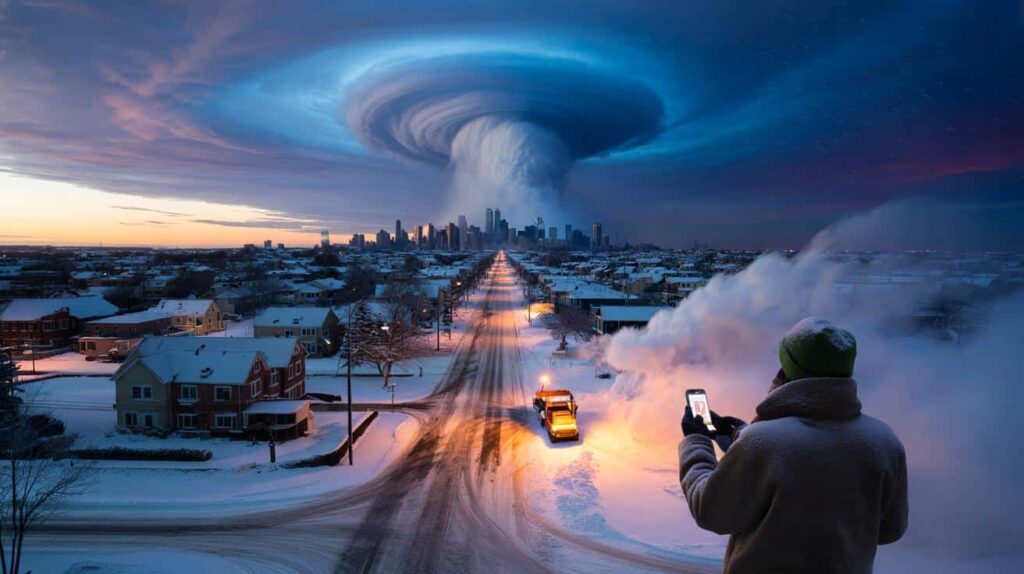
People in the Midwest felt the night the air suddenly went quiet before they even looked at their phones. The wind died down, the cold got sharper, and neighborhoods that had been messy and mild just a few days before became eerily quiet. Streetlights glowed in frozen halos, breath turned to fog, and a plow rattled by on bare pavement in the distance, as if it knew something we didn’t. Then the alarms started to go off. “Big change in the pattern.” “Arctic outbreak possible.” “Polar vortex disruption is happening.” The maps on TV were deep purple and got darker as the forecasts got closer to the south. You didn’t have to be a weather nerd to know this wasn’t just the usual winter cold coming back. This felt like the start of something bigger.
What a polar vortex disruption really means for people on the ground
The polar vortex sounds like a bad guy from a sci-fi movie, but it’s very real on a January night. It’s a ring of icy winds that spins high above the Arctic. Most of the time, it’s strong enough to keep the coldest air far to the north. But if that ring wobbles or breaks, the gates will open. Cold that “belongs” over the pole spills south, flooding cities that were wearing light jackets just a week ago. By morning, the roads that were wet at dinner turn into black ice. By Tuesday, flights that seemed safe on Sunday had turned into a week-long mess of cancellations.
We have seen how severe these events can become. In February 2021 a major polar vortex disruption brought extreme cold to the central United States. Texas is a state designed for hot weather but temperatures stayed below freezing for several days. The power grid failed completely. Millions of homes experienced burst pipes. Some families burned their own furniture just to stay warm. In the Midwest snow accumulated into massive drifts that towered over children who waited for school buses that never arrived. Hospitals became overwhelmed with patients suffering from hypothermia & carbon monoxide poisoning so cities quickly opened emergency warming centers. That disruption caused widespread damage. The current polar vortex event is already displaying signs that it could be equally severe.

Meteorologists are keeping an eye on a classic chain reaction. The polar vortex winds high up in the stratosphere start to slow down and warm up first. Then that disturbance “drips” down, changing the jet stream, which is a fast-moving river of air that guides our storms. When the jet stream bends, cold air can go to places it shouldn’t, and warm air can flow into the Arctic. Places that were talking about spring bulbs are now looking at blizzard warnings. The science is hard, with models stacking probability maps on top of historical analogs. But the lived result is simple: your local weather can change like a switch, and the dangers don’t come one at a time.

How to get through the cascade, from ice to snowstorms
Picture the approaching storm like falling dominoes. Your goal is to move aside before they topple. Start with simple preparations: warm clothing an alternative heating method, and a strategy for sheltering at home if travel becomes unsafe. Inspect your house for vulnerabilities right now instead of waiting until bad weather arrives. Apply salt or sand to your walkway the day before temperatures fall rather than during the first icy rain. Items like phone chargers, portable batteries, and a battery-operated radio transform from forgotten drawer clutter into essential tools. If you take prescription medication, refill it before the storm gets a forecast name.
Most people wait until they see the official big news before they do anything. By then the de-icer is sold out and the only bread left is the kind nobody wants. You might also fall into the trap of remembering the last forecast that was wrong and deciding to ignore this one. Nobody really checks the weather every single day. But there is one simple thing you can do to help yourself. Pick one source you trust like a local weather person or a good app and set up one alert. For example when the wind chill drops below zero you know it’s time to prepare.
“People don’t panic because of the cold itself,” says one experienced forecaster.”They panic because the dangers come at them faster than they can handle them—ice, then whiteouts, then power outages.” Getting ready is about making that chaos go slower.
Keep a blanket in your car during winter along with a flashlight and some snacks. Add a basic first aid kit & include a small shovel as well. These items can help if you get stuck or stranded in cold weather.
Keep a “72-hour bin” at home with water, food that won’t go bad, and a way to stay warm without electricity. Plan to check in on one neighbor, especially an older or lonely person, before and during the coldest nights. Before each big wave of snow or ice hits, make sure all of your devices are charged. Please follow road closures and blizzard warnings. No errand is worth driving blind in a whiteout.
The emotional weather that goes along with the forecast
We all know that feeling when you open the curtains and discover everything has changed overnight. Cars buried under snow. Trees coated in thick ice. A city gone eerily quiet. A polar vortex this powerful does more than drop temperatures. It disrupts plans and budgets and daily life and peace of mind. Parents suddenly juggle remote work with unexpected snow days. Gig workers face a tough choice between earning money and risking dangerous roads. Weather stops being something in the background and becomes the main event.
These cascading dangers don’t usually come with clear labels. The change can start with a light, almost pretty glaze of freezing rain and then turn into a full-blown blizzard with gusts of 50 miles per hour. There is a short time in between when choices are very important: cancel that trip, change that appointment, or reschedule that delivery.This is the moment when being quiet turns into protection. Some people will just say, “It’s just winter,” but others will be counting every degree on the thermometer like a clock.
There is a simple truth behind all the scary maps and technical language: weather on a heating planet is getting stranger at the edges. Not every cold snap proves that, but the pattern of extremes—sudden changes from warm to bitter, from rain to crippling snow—is getting harder to ignore. When the polar vortex acts up, it reminds us how fragile our routines are. How much depends on power lines staying up, trucks staying on schedule, and air currents thousands of miles away keeping their usual shape. We will have another real-life stress test in the next few weeks. Not just of our infrastructure, but also of our habits, our neighbors, and how ready we are to read the sky before the news.
Important point detail: Value for the reader
| Disruption of the polar vortex | Arctic winds that are getting weaker and wobbling, letting extreme cold move south |
|---|---|
| Cascading risks | Sequence of events: ice, heavy snow, blizzards, and power outages |
| Practical preparation | A home kit, a car kit, a reliable source for weather forecasts, and early action triggers. These things lower risk, stress, and last-minute scrambling when the cold hits. |
Questions and Answers:
Question 1
What is the polar vortex, and does it always mean that I will be very cold?
Question 2
How is this disruption different from a regular winter cold front?

Question 3
# Can a Polar Vortex Disruption Cause Both Blizzards and Ice Storms? Yes a polar vortex disruption can definitely trigger both blizzards and ice storms. When the polar vortex weakens or splits apart, it sends extremely cold Arctic air southward into regions that normally experience milder winter weather.
## How the Polar Vortex Works
The polar vortex is a large area of cold air that typically stays contained around the Arctic region. Strong winds circling the North Pole act like a fence that keeps this frigid air locked in place. When this system becomes unstable the cold air escapes and moves into lower latitudes.
## Creating Blizzards
When Arctic air from a disrupted polar vortex meets moisture from warmer air masses, it creates perfect conditions for heavy snowfall. The dramatic temperature difference between the cold and warm air produces intense storms. If these storms also bring strong winds exceeding 35 miles per hour & reduce visibility to near zero, they become classified as blizzards.
## Generating Ice Storms
Ice storms occur when the temperature profile of the atmosphere creates specific layering conditions. During a polar vortex event, cold air sits near the ground while warmer air exists in layers above it. Precipitation falls as rain through the warm layer but then encounters the freezing air near the surface. This causes the rain to freeze on contact with cold surfaces like roads, trees and power lines. The result is a coating of ice that can cause widespread damage and dangerous conditions.
## Why Both Can Happen
A single polar vortex disruption can produce both types of storms in different locations or at different times. The exact weather outcome depends on local temperature patterns, moisture availability & how the cold air interacts with existing weather systems. Areas closer to the core of the cold air mass typically see blizzards, while regions on the edges where temperatures hover near freezing are more likely to experience ice storms.
Question 4
How far ahead can forecasters see a big problem coming?
Question 5
What are three easy things I can do this week to get ready?