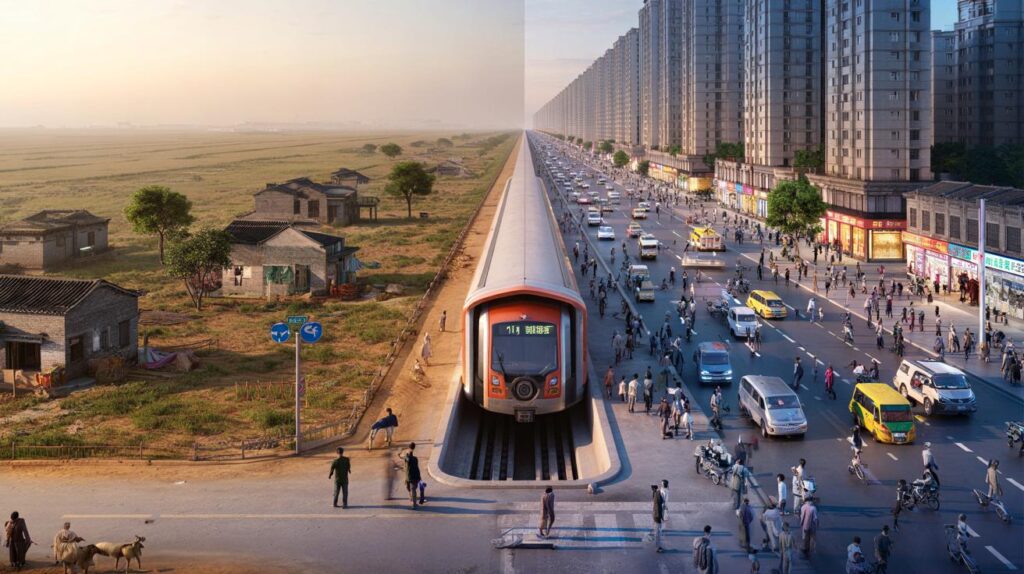
There were fields, old brick houses, and a single billboard that was half torn by the wind on either side of the road. Out of nowhere, a shiny concrete building appeared. Glass panels glowed, and a big blue ‘Metro’ sign pointed to a staircase that looked like it was going to sink into the ground. No malls, no towers, no people. There was only a station in an empty field, like a prop from a sci-fi movie.
The driver snorted and said something that made everyone on the bus laugh.
A tube that goes nowhere. That was the punchline.

We didn’t know what the punchline was yet.

From “stations in the fields” to waiting in city centers
These kinds of scenes started to show up all over China around the time of the Beijing Olympics. There were sleek subway entrances next to corn fields, muddy roads, and two-story farmhouses with laundry hanging out to dry. It felt like a dream for a lot of people who came from other countries. You’d get out of a clean, air-conditioned tube car and see a goat tied to a pole and an old man selling sunflower seeds.
The question hung in the air, unspoken: who on earth is going to use this?
Chinese city planners called this plan “stations in the fields.” Lines like Beijing’s Line 4 and Line 13, parts of Shanghai’s huge network, and parts of Shenzhen’s early extensions went deep into areas that were barely suburbs at the time. Some stations had more construction cranes than people who worked there.
Early social media had pictures of empty platforms, quiet escalators, and lonely ticket machines. People shared them as proof of too much, calling these places “ghost subways,” which is similar to the famous “ghost cities” story that Western media loved. It fit a simple story: China was building too much.
We didn’t see that those fields weren’t supposed to stay fields. Local governments had already drawn out the future skylines on their planning maps. The tube didn’t help that growth; it started it. Once a station was confirmed, the price of land went up a little. Developers came with shiny brochures that promised a “metro lifestyle.” Families spent more than they could afford on apartments because there was a line nearby, even though it seemed crazy at the time in 2008.
In many places, the “waste” we laughed at was a down payment on a future city.
Now that it’s 2025, who’s laughing?
Take the case of Tiantongyuan in Beijing, which used to be called a “remote bedroom community” at the end of the line. People complained about moving there in the late 2000s, just like people in other places complain about being sent to the edge of the world. The metro station was there early, but there weren’t many people using it and there was a lot of speculation.
At 8:30 a.m. in 2025, you’ll be swept away by a river of bodies, shoulder to shoulder, with every square metre of platform claimed.
Or you could go to Pudong in Shanghai, where in the early 2000s, whole stretches of new lines ran past empty lots and lonely high-rises. A lot of foreign experts pointed to aerial photos and said, “Look, no one lives there” back then. Today, malls, office parks, schools, and residential blocks with glowing windows at night are all anchored by those same stops.
What used to be a joke about “subways built for ghosts” is now a daily reality of record-breaking ridership, trains that are too full to fit everyone, and rush-hour trains that are so full that you need two or three passes to get on. Cities that seemed too big on paper are now trying to figure out how to add trains or platforms just to keep up.
From a distance, it looks like luck or spending a lot of money. The pattern is more planned on the ground.
First, China built transportation, and then density. In many Western cities, debates go on for years until the population pressure becomes too much, land prices go up, and only then does a transit line come into being. You can see the changes in how people commute, how many cars they own, and even where young people choose to live by 2025.
Let’s be honest: no one really does this every day, but if you spend a week in a Chinese mega-city without using the underground, you’ll see how important those early, “naive” investments have become.

What we can learn from this long-term thinking
The show has a simple, almost boring purpose: to move people to where you want them to live and work, not where they already are. Chinese planners made plans for future residential areas, university campuses, and industrial parks. Then they built rail lines straight to those future hubs, long before coffee shops and daycare centers opened.
It’s like putting the veins in place before the body is fully grown. The next shape is less random and more connected.
At that point, land near the center is too expensive, cars are everywhere, and every new project leads to years of protests, lawsuits, and budget fights. People thought about China’s empty stations in 2008 in this short-term way.
We’ve all had that moment when we see a new tram line or bike lane that isn’t full and think, “Nobody’s using this, what a waste.” But adoption is often slower than infrastructure. Usage grows into space that is already there; it doesn’t just appear out of nowhere.
The Chinese case has a simple truth hidden in it:
cities get the transport they have the guts to build early. One night, while I was eating instant noodles in a station canteen, a former planner in Chengdu told me this:
He said, “People said we were crazy to run trains to fields.” “Those fields are gone now.” People only complain that the trains are too full.
- Plan rail with a 20–30 year time frame, not just the next five years.
- Put stations where you want future density, not just where there is demand right now.
- Take a few quiet years now so you don’t get too busy later.
Being naive, looking back, and the price of not seeing things clearly
By 2025, when you walk through those once-empty stations, you get a strange feeling of déjà vu and mild embarrassment. Foreign headlines used to call the platforms absurd overreach, but now they are just normal places for teens to watch short videos, grandparents to carry groceries, and office workers to power-walk between connections. The emptiness that made such great pictures has been replaced by real life.
The joke got old. The concrete didn’t.
The story of the 2008 stations in the middle of nowhere is less about China and more about how we think about time. When we compare things to what we need today instead of what we need tomorrow, we call them naive. We swipe through pictures of empty buildings and think that quiet means failure. Then, one day, we get off a train in a busy area that used to be farmland and realise the joke was on us.
Main point Information that is useful to the reader
- Construct transit prior to density – Chinese subways got to “fields” years before towers and malls did. Gives you a mental picture of how your city’s infrastructure will look in the future.
- Expect a time of peace – Early “ghost” years turned into crowded trains and grown-up neighbourhoods. Helps you see “empty” projects as seeds instead of mistakes.
- Don’t just think about elections – Lines were planned for 20 to 30 years in the future, even though they got a lot of criticism at first. Encourages patience and support for big projects that look to the future.
Questions and Answers:
Question 1: Were those “ghost” tube stations in China really empty in 2008?
Answer 1: Many of them didn’t have many passengers at first, especially terminal stations near farmland or construction sites. But they were built with the idea that they would get more passengers in the future.
Question 2: Did all of those early metro extensions ever get full?
Answer 2: Most urban lines in big cities like Beijing, Shanghai, Shenzhen, and Chengdu are now very busy. However, some edge stations and smaller-city projects still seem to be underused.
Question 3: Was this just a political show, or was it real planning?
Answer 3: There was politics and prestige, but there was also detailed planning for land use that connected new residential areas, business parks, and universities directly to future transit lines.
Question 4: Could cities in the West or in developing countries use this “build first” plan?
Answer 4: Not at the same speed or scale, but the main idea—connecting long-term housing and jobs with early transit—can definitely be used in smaller, phased projects.

Question 5: What does someone stuck in traffic today learn about themselves?
Answer 5: When new transit or bike lanes look “too empty,” think about China’s 2008 stations: supporting them early is how you get a livable city later.