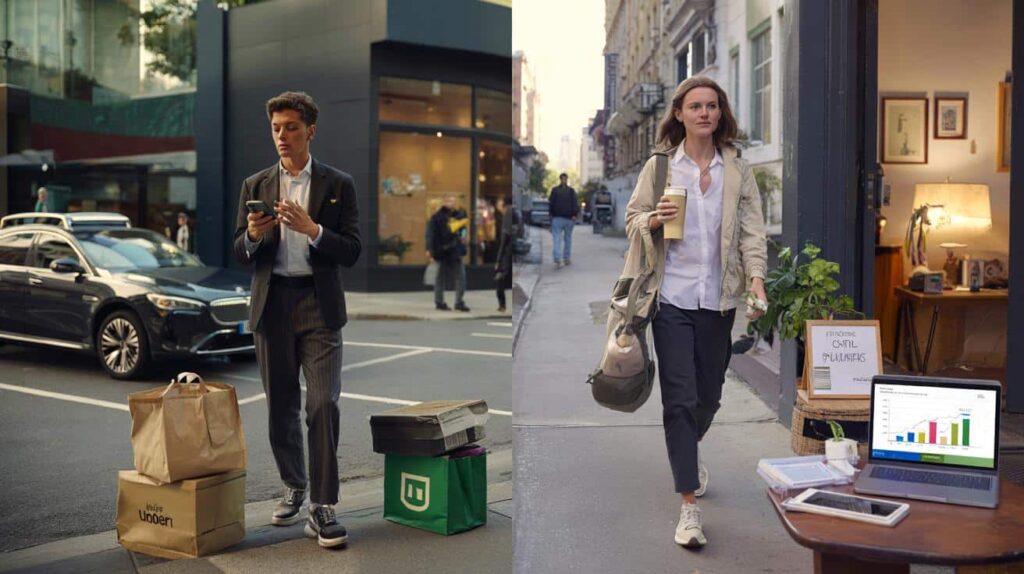
Two friends who make the same amount of money go into a coffee shop. One person taps their phone, orders a big latte, and then calls an Uber for three blocks because it’s “just easier.” The other one checks their balance first, sighs, and says, “I’ll get one at home.” They both roll their eyes for different reasons, and life goes on. Not a big deal, right? A few small choices you make every day that don’t seem like they matter.
Now, go ahead ten years.
One of them has a down payment, a nice emergency fund, and the ability to say yes to a last-minute trip. The other person is still trying to figure out where the money went.

The weird thing is that the gap was made by choices that were so small that they couldn’t be seen.

The small improvements that are slowly taking away your future
If you walk through any city at 8:30 a.m., you can almost hear money leaving people’s accounts. Noise-cancelling earbuds, hot drinks in branded cups, and food-delivery scooters weaving through traffic. None of these things are too much to pay for. They’re “little treats,” “deserved upgrades,” or the kind of convenience that feels normal after you’ve done it a few times.
Most of us don’t spend too much on yachts. We spend too much on slightly better versions of the same day.
Take the classic “coffee upgrade” that everyone loves to make fun of and then ignore. If you trade your $1.50 home coffee for a $5 latte on weekdays, That’s an extra $3.50 per workday, about $70 per month, and about $840 per year. Add in the “I’m tired” Uber that takes the place of a $2 bus ride once or twice a week and the delivery fee when the fridge is too much to handle.
All of a sudden, that’s not a meme anymore. It’s money for rent, a flight, or a piece of credit card debt that could have gone away.
One latte or one Uber ride won’t break the bank. It has to do with how our brains make “small” upgrades seem normal. When your baseline changes from “I cook” to “I order” or from “I walk 15 minutes” to “I ride 5 minutes,” you’re no longer making a choice. You are simply living your new normal.
That’s why people say they’re “being pretty careful” with their money but still feel poor all the time. The upgrades blend in with normal life.
The quiet maths of lifestyle creep (and how to stop it)
Ask yourself one question to begin: “What is my default setting for a normal day?” Not a holiday, not a special event, just a Tuesday. Make a list of the things you usually buy from morning to night. Coffee, snacks, lunch, getting around, streaming, and random purchases while scrolling. Don’t make a judgement. Just catch it in the wild.
Then, for each line, write a lower price that you would really be okay with. Not a dream. A swap you’d be okay with most days without being angry about your life.
Most people start “no-spend challenges” right away and fail by day three. They go from getting food delivered four times a week to saying, “I’ll cook in batches every Sunday and never eat out again.” To be honest, no one really does this every day. Guilt grows and progress dies in that space between what is ideal and what is real.
Choose one area where the “small upgrade” has become the norm without anyone noticing. It could be rides, lunch you ordered to go, or subscriptions you haven’t opened in months. Not 100%, but 30–50% less on that single lever.

- Coffee, snacks, and fancy drinks that used to be treats but are now part of your daily routine.
- Micro-conveniences are things like Ubers, same-day delivery, and “express” options that save you five minutes but cost you five dollars.
- Invisible subscriptions: apps, platforms, and memberships that charge you for a lifestyle you don’t actually live.
- Comfort upgrades: brand-name groceries, new clothes all the time, and nicer but not necessary things for the home.
- Social spending creep means saying yes to every drink, brunch, and group activity just to keep the mood up.
Making small improvements into big advantages
This is the part that almost no one does: giving those saved dollars a job. If you stop spending $80 a month on upgrades that don’t make you happy and just leave it in your checking account, your brain will find a way to spend it on something else that you won’t remember. Instead, send every “downgraded” dollar to a different account the same day you downgrade it.
Give it the name “Future Flex Money.” Not savings, not an emergency fund, just the extra money that gives you more options later.
A lot of people make a terrible mistake when they first get a rise. They upgrade everything at the same time. Better flat, nicer groceries, more nights out and a new phone ‘because I can now’. Six months later, their account balance is the same as it was before the rise. No extra safety, just more stuff.
A gentler way to do it is to tell yourself, “Every time my income goes up, only half of it can go to my lifestyle.” The rest goes to investments, debt, or the “Future Flex” account. It’s boring right now, but it will be very powerful in the future.
The truth is that small changes to your lifestyle aren’t bad; they just cost a lot when they’re automatic.
If you pick your Friday takeaway on purpose and really enjoy it, you are spending your money wisely. When you upgrade because you have to, not because you want to, that’s when the problem starts. That blur is where thousands of dollars that could have been made are lost over ten years.
Bringing attention to those choices doesn’t take away happiness. It lets you give up a little convenience today for a lot more freedom tomorrow.
The part that no one can figure out for you
The question changes from “How much could I save?” to “What do I really want my money to do for me?” at some point. It’s important to look at the numbers, but they’re not the whole story. If you walk instead of taking an Uber, you’ll get an hour of fresh air and save $60 a month. That’s good for your money and your mood. The math changes if you feel lonely when you cancel a streaming service because that’s how you relax with friends.
The magic happens when you choose your upgrades on purpose, not because of old habits or peer pressure.
You don’t need a PhD in spreadsheets to change your course. You need to take a few honest looks at your “normal” day, be okay with one or two small cuts, and know exactly where that extra money will go. As time goes on, those small choices add up to a very big safety net.
Others will read this, nod, and then go back to their feed. Some people will stop at the next checkout screen and ask, “Is this an upgrade I really want, or just the one I haven’t seen in a while?”
Those answers won’t have any financial effects until tonight. In five years, a friend will say, “You’re so lucky you can afford that,” and you’ll know it wasn’t luck at all. It was the effect of a hundred small, mostly invisible decisions that built up over time.

That’s the part that no budgeting app can fully capture: the quiet moment when you realise that your future is worth more than a slightly better version of today.

Main pointValue for the reader in detail
- Find out how much you spend on your “default day.” Make a list of everything you usually buy on a weekday, then write down some realistic, cheaper options. Shows invisible lifestyle changes without judging them.
- Take one category down at a time. Instead of trying to change everything, cut 30–50% of small upgrades in one area. Makes change last longer and hurts less emotionally.
- Put your saved money to work. Put every “saved” dollar into a separate account that is labelled for future freedom. Changes small cuts into visible progress and long-term flexibility.