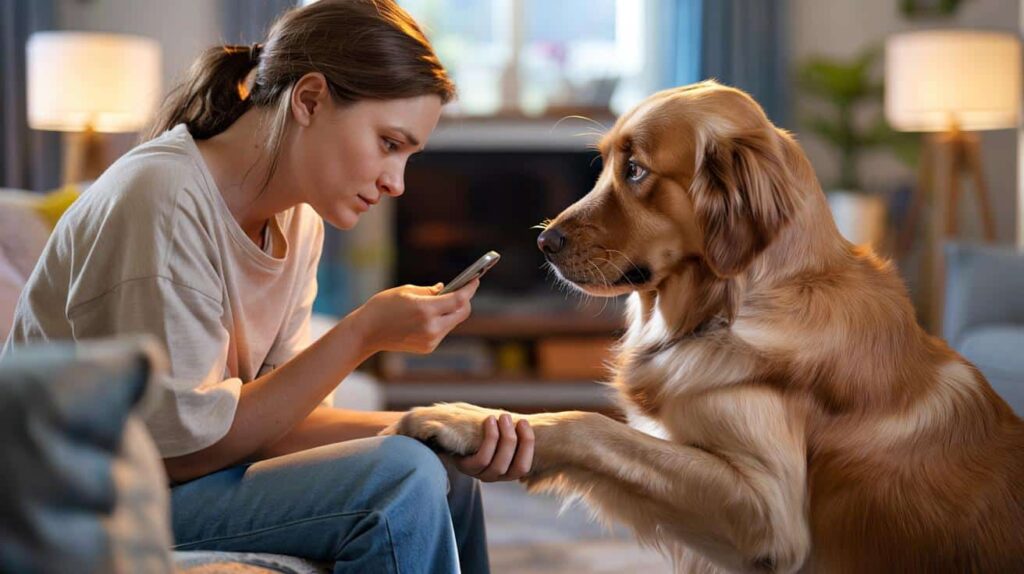
You feel it while you’re sitting on the couch and scrolling through your phone. A warm paw is gently pushing on your leg. You know those eyes your dog is looking at you with. You smile and say, “Oh, you want to say hello?” and then you grab the paw like you’re going to shake hands. You might even post the scene on Instagram.
Then the paw comes back. Again. And again. Sometimes firmly, other times almost shyly. Not always at the right time. Not always when you want to.
There is more going on behind that small, furry gesture.

And once you see it, you can never look at that paw again.

What your dog means when it gives you its paw
Most of us learned “give the paw” as a trick to show off to family and friends at parties. So we’ve linked the gesture to play, learning, and that proud “good boy/good girl” moment. But for dogs, this movement often seems to be far away from any training session.
You might notice it when you’re sad on the couch, on a work call, or when someone in the next room starts yelling. The paw comes like a period.
- This isn’t just a greeting for your dog; it’s a message full of feelings and needs.
- And it’s your job to read it.
In Lyon, a behaviourist is following a three-year-old golden retriever named Luna. Her owners said she was “clingy.” Whenever the couple sat down together, Luna would get in between them and put her paw on one of their legs. She got more and more angry as they ignored her, climbing, scratching, and almost begging.
They thought it was either jealousy or a request to play. They tried to get her to leave, then they laughed it off, and then they gave her toys to play with. Things stayed the same.
The pattern jumped out when the behaviourist filmed their evenings.
Most of the time, Luna raised her paw when the owner’s voice got tense or when one of them picked up their phone and checked out emotionally.
Animal experts say that the paw is often a subtle mix of communication and control. Dogs naturally use their paws to touch each other, ask for space, calm down a partner, or ease tension while playing. They use the same codes with people.
So “paw” can mean “I need comfort” or “I’m a little lost, are we okay?”, “Listen to me, something’s wrong,” or even “I’m stressed, help me calm down.”
Your dog isn’t trying to be cute for social media; it’s trying to get you to understand what it’s saying.
The whole relationship changes when you stop seeing the paw as a trick and start seeing it as a sign.
How to act like a real partner when you get a paw, not a robot
Don’t automatically shake hands with your dog when it puts its paw on you. Stop. Take a deep breath. Take a look at the whole thing.
What’s going on around you? Is there noise outside, a stressful TV show, kids running around, a door banging, or your own stress level going up? Look at your dog’s body. Are the ears slightly back? Are the eyes soft or wide? Is the breathing fast? Is the tail relaxed or stiff?
In just five seconds, this micro-scan changes everything.
You can then decide if your dog needs contact, calm, space, or a little bit of structure right now.

A lot of people just push the paw away or say “enough, stop it” without even looking. They aren’t mean; they’re just too busy. We’ve all been there: when the dog won’t stop asking for something and it’s the end of a long, tiring day.
Your dog might learn, “When I reach out, I’m turned down or scolded.” The gesture either gets worse and turns into scratching and jumping, or it goes away under a layer of quiet acceptance.
Let’s be honest: no one really figures this out every day.
But even small, imperfect things you do can make your dog feel safe and heard.
When talking about the paw, animal experts often use words like “bridge,” “invitation,” or “anchoring.” This is how one veterinarian behaviourist put it:
You can keep a simple mental box of options to show more respect for this gesture:
- If your dog seems nervous, put your hand on its paw and talk to it softly.
- If the pawing is too much, tell them to do something calm, like lick a mat or chew.
- If there is a lot of tension at home, get up and change the setting.
- Teach your dog to “go to your mat,” and then reward calmness instead of insistence.
- If your dog is pawing and also panting, pacing, or whining, talk to a behaviourist.
You have heard the message in each option.
Having a dog that “talks with its paws”
You might notice that your dog “talks with its paws” a lot once you start paying attention. When there are thunderstorms, when you’re on Zoom, when a stranger comes into the house, or when you’re crying in the kitchen. The gesture works like a radar for everything that’s going on below the surface.
You might even feel a little bad about all the times you laughed or ignored it. That’s normal. Guilt is often the first step toward getting better attention.
Dogs don’t need to be perfect. They need to be there.
Responding to that paw doesn’t mean giving in to every request or spoiling someone. It means accepting that a living thing just knocked on your emotional door.
Main point
- Information that is useful to the reader
- Look at the context – Pay attention to the environment, body language, and timing of the paw. Helps you figure out what your dog really wants.
- Don’t react; respond – Instead of pushing away, offer calm contact, redirection, or structure. Lessens stress and stops bad behaviours from getting worse.
- Get help from an expert if you need it – If your dog is pawing at you and showing signs of anxiety, see a behaviourist or a vet. Keeps your dog healthy and strengthens your bond with him.
Frequently Asked Questions:
Why does my dog put its paw on me when I stop petting it?
It’s often a polite way of asking to keep in touch. Your dog has learned that your touch makes him feel better, so he just says, “Don’t stop yet.” If it gets too pushy, you can either start over gently or give it a calm cue.
When my dog puts its paw on me, is it being dominant?
Most experts say no. In the vast majority of cases, the paw is a request for interaction or reassurance, not a power move. When people talk about “dominance,” they are usually hiding stress, habit, or learned behaviour.
What should I do if my dog scratches me with its paw?
Take a deep breath, look away for a few seconds, then ask for a different behaviour that is more acceptable and reward it. When the dog learns that gentle pawing is ignored, it often starts to scratch.
Why does my dog give me its paw when I’m sad or crying?
A lot of dogs are very sensitive to how people feel. The paw here is like a comforting touch, a way to check in and be there. It’s not really a trick; it’s more like an empathetic reflex.

Should I stop teaching “give the paw” as a trick?
Not always. The trick itself isn’t bad. Just keep it short, fun, and separate from times when you’re feeling emotional. And when your dog offers its paw outside of training, see it as communication, not a trick.